randomfacts
aviation - aviators page
On this page (scroll down)
 Thomas Gale 1871Carl Wilhelm (Bill) Wittber 1910H. E. Watkins 1911Arthur (A.W.) Jones 1914Frank Perry Watts WW1 RFCCarl Wilhelm (Bill) Wittber 1915Basil Watson 1917Harry Butler 1919Hubert Wilkins 1919Kenneth Albert Rawson WW2 RAAF/RAF DFC + BARReginald Albert Wild WW2 RAAF/RAF & Korean War RAN DFC Jon Johanson 2003
For women aviators, click here
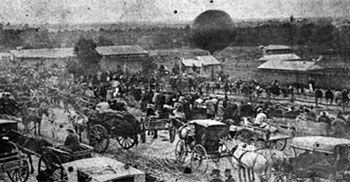
Thomas Gale 1871
South Australia's first recorded pre-aeroplane ascent was in June 1871 with a flight in a coal gas-filled balloon, piloted by American Thomas Gale. The balloon flew from the sheep and cattle markets near the corner of North and West terraces, Adelaide, to a point 12 kilometres north east, near Thorndon Park Reservoir. Lavinia Balford of Parkside was the first South Australian female to ascend in a balloon. Gale never left Adelaide. He married Lavinia Balford and lived in Parkside for the rest of his life.Trove [external website]
Adelaide Now[external website]
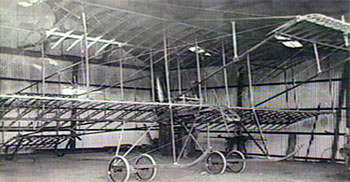
Carl Wilhelm (Bill) Wittber 1910
Adelaide businessman Fred Jones imported a Bleriot XI monoplane in 1910 and employed Wittber to supervise the aircraft's assembly and rigging, run the engine and oversee flight tests. During taxiing tests on 13 March 1910, Wittber tried 50%-60% power and the aircraft rose about five feet and travelled for about 40 yards. This was Australia's first aircraft flight. Four days later Fred C. Custance, made a flight but crashed on landing, wrecking the plane. He escaped injury.
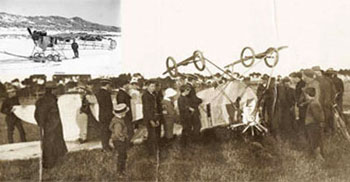
H. E. Watkins 1911
Douglas Mawson imported a Vickers-built REP monoplane from England in 1911 while preparing for his next Antarctic expedition. P&O shipped the plane on the steamship Macedonia to Adelaide in October 1911 with its pilot H.E. Watkins and also fellow expeditioners Bickerton and Wild. During a test flight on October 4 at Adelaide's Cheltenham racecourse, excessive pressure in the fuel tank caused it to rupture, almost blinding Watkins. On its second flight early next morning, wind caught the 34-feet-long aircraft at the south west corner of the racecourse, causing its left side to touch the ground and overturn. The monoplane was damaged beyond repair for flying but it was sent south with the expedition, stripped of its wings and metal sheathing from the fuselage and used as a tug for 4 sledges.
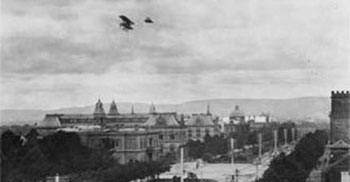
Arthur (A.W.) Jones 1914
A.W. Jones set up camp at Cheltenham for several weeks around late 1913. At 6.30am on 2 January 1914, he took off from Cheltenham Racecourse in his Caudron G II aircraft. After flying over the city he turned back to Cheltenham but veered off course to the north, before returning to his correct course. He ran out of petrol and was forced to make a crash landing in a paddock on the north side of Torrens Road. Extensive damage was done to the plane with both sides of the body crumpled, the chassis ruined, control wires and rudders twisted, and the skids and other woodwork snapped like matchwood. Jones' injuries were a strained left arm and cuts to his knees and mouth.
Frank Perry Watts
Frank was born on 30 April 1894 at Dawesley and attended school at Native Valley. He left school at 13 years of age and worked with his older brother, Clarence Watts, at a butcher shop at Nairne owned by their eldest brother Bert Watts. He learnt Esperanto, the universal language, and corresponded and communicated with nations around the world for the rest of his life. He was also fascinated with machines, modelling, photography and other challenging tasks as well as joining his brothers with their involvement in sports of all kinds. In 1915, he enlisted in the AIF and on the 21 May 1916, left for England on SS Afric. Frank arrived in England in 1916 as a driver in the Army Service Corp at Larks Hill, Salisbury Plains. He applied for and received a transfer into the Royal Flying Corp on October 16th 1916, at Denham. He trained as a pilot and in gunner and aerial photography. While on service in France doing aerial reconnaissance, his plane, an RE8 was hit. He and his observer survived the crash. Frank spent many months in an English hospital for rehabilitation. He became a full Lieutenant and was an instructor in aerial photography before his return to Australian in July 1919. Frank had a Morris car dealership at Murray Bridge and later worked as a photographer at Murray Bridge. In 1941, he was living at Berri. Franks Watts died at Strathalbyn on the 7th January 1964, he was buried at Milang.
Carl Wilhelm (Bill) Wittber 1915
Following his work on the Bleriot XI in 1910, Wittber designed and built his own Farman style bi-plane, including constructing a six-cylinder radial engine (an Australian first). The plane was test flown by South Australian aviator Harry Butler at Smithfield, SA. It was the first aeroplane built and flown in South Australia. The authorities stopped all trials due to wartime conditions and the last flight made at Smithfield was early 1916. Wittber then lost all interest in aviation and burnt the fabric in his bathheater at Dulwich where he lived. This aircraft did not survive, but the engine survived and is on public display at the South Australian Aviation Museum.
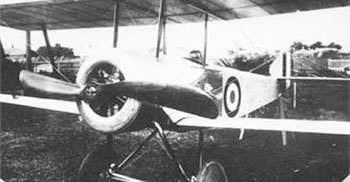
Basil Watson 1917
Basil Watson was the first man to fly into Mount Gambier (Mount Gambier Racecourse) on 14th February 1917. The day was reported to be very wet and very unpleasant for the spectators and his demonstration flight was often lost in the low clouds. Watson left the next day, heading for Melbourne.
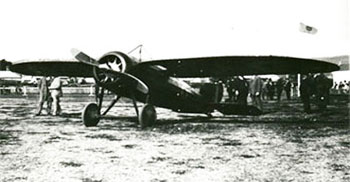
Harry Butler 1919
The first commercial flight in Australia was on 6 August 1919, when Harry Butler carried the mail by air from Adelaide to his home town of Minlaton on the Yorke Peninsula.
The aircraft was a Bristol M1-C monoplane (called the Red Devil) that he had brought back from England after WW1. This was also the first commercial flight over sea in the Southern Hemisphere. Butler entertained crowds regularly with his flying, and large crowds gathered to watch him 'Jetty Jumping' at Henley Beach. This aircraft is on display at Minlaton (York Peninsula) and is believed to be the only aeroplane of its type remaining in the world.
More about Harry Butler: adb.anu.edu.au/biography/butler-henry-john-5446 [external website]
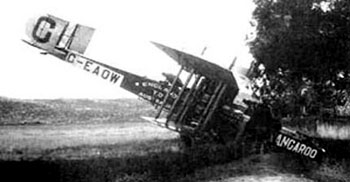
Hubert Wilkins 1919
Hubert Wilkins joined a five man crew hoping to claim a prize of £10,000 for the first flight from England to Australia by an Australian crew. Their plane was a Blackburn Kangaroo, a twin engine WW1 bomber. On December 8 1919 the port engine crankcase broke and lost its oil over water about 80 miles from Suda Bay, Crete. They reached the island but needed to turn on the faulty engine for manouvering. It exploded and many hot fragments penetrated the fuselage causing the pilot to attempt an emergency landing. Missing a village, but grazing the roof of the last house, they crashed into a field with a badly wrecked aircraft but all crew unharmed.
Kenneth Albert Rawson (WW2) DFC + BAR
Kenneth was born 24 August 1918 at Gilberton. He was an electrician. In late 1939, he joined the Militia, serving with Area 10B (Unley/Kensington/Norwood). On 9 July 1941 Kenneth enrolled in the RAAF Reserve. On 6 December 1941, Kenneth enrolled in the RAAF Citizens Air Force and commenced training at Victor Harbour with No 4 Initial Training School (Course No 23, B Squadron, Flight 15). Kenneth's flying training commenced at Parafield on 28 May 1942 (No.1 EFTS), where he completed 62 hours on the Tiger Moth. He then moved to Mallala on 10 Aug 1942 (No.6 SFTS) where he completed 125 hours on the Avro Anson. On 12 November 1942, he was awarded his flying badge (wings).On 9 January 1943, he embarked for overseas service from Adelaide, disembarking in England 6 March 1943, and was attached to the RAF. On 14 September 1944, Kenneth began bomber training where he flew the Oxford (120hrs), then Night Bomber training flying the Wellington (85hrs), then the Stirling (45hrs), then the Lancaster (15hrs), finishing with the P.N.T.U. Tactical Exercise Unit flying the Lancaster (15hrs). On 12 May 1944, he was discharged as an Airman (RAAF) and appointed as Pilot Officer (RAF). On 28 July 1944, Kenneth was assigned to No.7 Squadron at Oakington, where he began his first tour with No. 7 Squadron (Pathfinders). He flew 1st Pilot 169hrs and 2nd Pilot 11hrs (total 180hrs). On 6 November 1944 he was promoted to A/F/Lt. and finished the tour January 1945. His second Tour was from January 1945 to 21 April 1945, again with 7 Squadron Bomber Command. One documented mission was the Hamburg Oil Refinery Raid on 31 March 1945. Wing Commander Cracknell served as the "Master Bomber" (Callsign Deckhouse) to orchestrate the raid from above the target. Flight Lieutenant Rawson was appointed as the Deputy Master Bomber (Callsign Deckhouse 2). Rawson flew low over the target area to monitor the accuracy of the yellow and red target indicators, prepared to instantly take over command of the entire bombing fleet if the Master Bomber's aircraft was shot down. On 2 April 1945, he was promoted to Squadron Leader (on demobilisation) and on 13 April 1945, he was awarded the Distinguished Flying Cross (DFC). Some sources say he flew 51 sorties buy one source says 60+ sorties. On 18 June 1945, Kenneth embarked U.K. and disembarked at Sydney 24 July 1945. On 26 September 1945, he was discharged and on 16 November 1945 he was awarded the Bar to his Distinguished Flying Cross. If you wish to know more about Kenneth Albert Rawson, please contact me at enquiries@randomfacts.com.au. 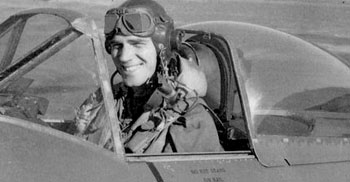
Reginald Albert Wild DFC RAAF (WW2) & RAN (Korean War)
Reginald Albert Wild was born 16 June 1922 at Laura, South Australia and was educated at Laura Public School and Gladstone High School, graduating as an honours student. He enlisted the day he turned 18 years old in Adelaide. He was awarded his flying badge on 24 July 1941, graduating from No.11 Flying Course at RAAF Base Forest Hill (renamed RAAF Base Wagga in 1952) after 50 hours in the DH.82 Tiger Moth biplane and 105 hours in the CAC Wirraway. On 16 Oct 1941 Reg went to England and trained on the Hurricane before being posted to Aden on 30 May 1942 and converting to the P-40 Kittyhawk.
Reg flew in the RAF 112 Squadron for 13 months performing ground attack and escort duties. On 23rd April 1943, he was awarded the DFC. He commenced a second tour on 14 April 1944 with No.3 Kittyhawk squadron before being transferred back to 112 squadron as 'A' flight commander, flying the P-51 Mustang Mk.lll. He returned to Melbourne on 12 Feb 1945 with over 1,000 hours flight time with the rank of Flight Lieutenant.
He was appointed to the RAN on 5 Jan 1948 and after 'sea training', returned to England to train on the Sea Fury before being posted to Korea between Oct 1951 to Jan 1952. He then became Lieutenant Commander of 850 Squadron at Nowra on 16 Dec 1952. On 17 May 1953, Reg was involved in a fatal flying accident at Wagga Wagga. He was 30 years old.
If you wish to know more about R.A. Wild, please contact me at enquiries@randomfacts.com.au. 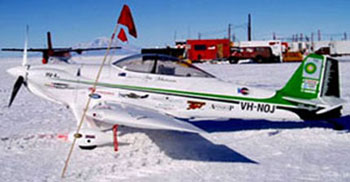
Jon Johanson 2003
In 1990, Jon Johanson purchased a Van's RV4 kit plane. He worked on it for two years (2,000 hours) and it was registered in 1992. He flew this homebuilt aicraft around the world three times. In 2003, he made the first solo flight in a single-engine home-built aircraft over the South Pole. After landing at the McMurdo-Scott base he became stranded when the base, not wishing to encourage future private flights, refused to sell him fuel. After a fuel donation by fellow adventurer Polly Vacher, he was able to fly on to Australia, via New Zealand.
Copyright randomfacts.com.au 2026
You may not reproduce or communicate any of the content on this website, including files downloadable from this website (unless otherwise indicated).
 enquiries@randomfacts.com.au
You may not reproduce or communicate any of the content on this website, including files downloadable from this website (unless otherwise indicated).
enquiries@randomfacts.com.au