randomfacts
businesses - brickyards page
The Coppin, Watts and Childs brickyards were all operated by my direct ancestors. James Coppin and John Watts were both my Great x3 Grandfathers, while James Alfred Childs was my Great Grandfather.
The history of these brickyards is not well documented online and what exists is almost all a load of poorly researched rubbish. It doesn't help when the Littlehampton Brick Company continues to circulate that they were established in 1892 (actually 1912) and continue to circulate a fictional story on their "Our Story" webpage that gives the impression that they were the first brickyard in Littlehampton. It also doesn't help when the Mount Barker District Council circulates this misinformation on their website, as do many others. I'm not being mean about this, I have offered to provide an accurate historical profile to Littlehampton Bricks for free twice, but they have not taken me up on the offer.
Early Brickmaking
By 1839, Nairne and Mount Barker had both been surveyed and settled. Reports of early brick makers are scarce, but in the early 1840's, a Mr. Hombin started making bricks near the Great Eastern Hotel, Littlehampton. The pug hole was on the Balhannah Road, near the property which is now No. 5 Balhannah Road. This location is also where the Coppin family had their pug hole a few years later. By 1847, Mr. Hombin and Mr. Love were making bricks just east of where the Mount Barker railway station is now and Mr. Alexander McDonald was also making bricks in 1847 near the corner of the present Mount Barker Showgrounds. In the early 1850s, there are reports of bricks being made by Mr. Moses Wraight and Mr. Thomas Weller but I haven't been able to confirm actual dates or locations for them.
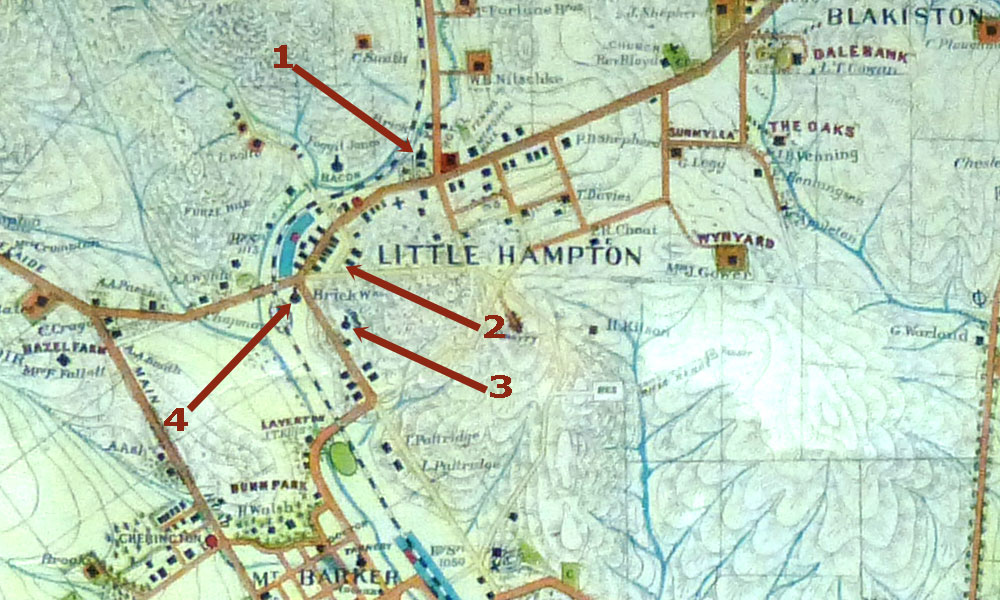
2. L.T. Watts 1889-1893 then S.A. Firebrick Co. 1893-1910
3. Childs Brickyard 1895-1973 (on Childs Road)
4. Littlehampton Bricks 1912-1970
James Coppin Brickyard 1856-1935
James Coppin was a brick-maker from Kent, England. In 1856 James (aged 41) and his family arrived in South Australia on the ship 'Gomelza', moved to Littlehampton and started making bricks. The brickyard was located at the end of Coppin Road Littlehampton. This location is either the same one Mr. Hombin used in the 1840's, or immediately adjacent (behind No.5 Balhannah Road). Several of his children had worked in the brickyards at Kent before coming to South Australia including Ann, who married Stephen Childs (two of their sons, James and Stephen started Childs Bricks in 1895). James Coppin (senior) passed away in 1866 and the brickworks continued under the management of his son James Alfred Coppin for many years. James (junior) later married Louisa Lucretia Watts (her father was John Watts of the Scott Creek brickyard). The Coppin family brickworks were in production for nearly 80 years and finished up around 1935. It was reported that the Coppin brickworks produced excellent quality bricks for many years for the hills and Adelaide areas and had a huge impact on the early development of the district.
Click Here for more information about this brickyard [.pdf]
John Watts Brickyard 1858-1985
John Watts came to South Australia with his wife and an infant son on the 'Coromandel', arriving on 12 January 1837 at the very beginning of the colony and lived in a tent in the sandhills at Holdfast Bay. John started making bricks in 1838 at Hindmarsh, with clay dug from the banks of the River Torrens. In 1858 he moved to the hills (called the tiers at the time) and established a brickworks at Scott Creek (near Nairne). It was originally set up to manufacture fire bricks which were used in smelting works at Scott Creek, Kanmantoo and Clare. The brickworks also supplied fire bricks to smelting works at Wallaroo and Moonta. Some time later, low cost fire bricks were being shipped in from England, making fire brick manufacture in the hills uneconomical for a time and the Watts brickyard was known for producing good quality red house bricks. The Watts family (Scott Creek) brickworks were in production for about 125 years and closed in 1985. Click Here for more information about this brickyard [.pdf]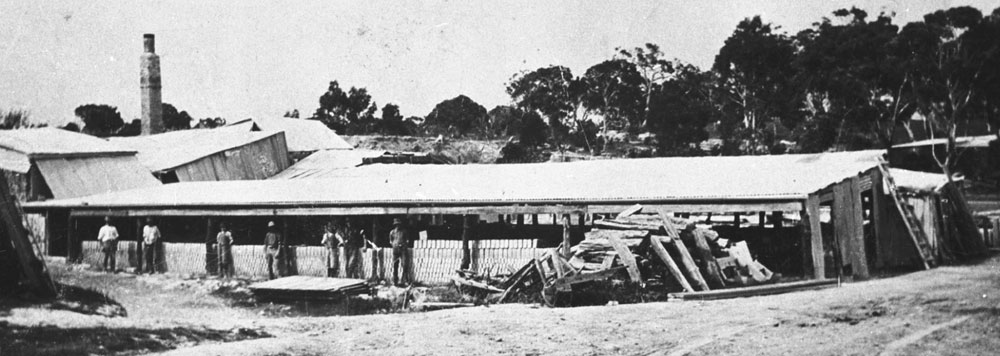
L.T. Watts Brickyard 1885-1893
Luke Theophilus Watts worked with his father at the Scott Creek brickyard for many years. When the railway was being constructed in 1883, Luke had a contract for construction of earthworks for a section between Mount Barker Junction and Little Hampton. He also had a jam factory and ran the post office at Little Hampton. Family histories say that Luke Watts started making bricks at Little Hampton in 1885, on the corner of Hallet Road and Childs Road (behind his shop), with the help of his father John Watts. The earliest advertisements for Lime and Bricks that I have found was October 1885. In June 1889, it was reported that Luke Watts has contracted with the Westport and Port Pirie Coke Company to supply 250,000 firebricks for the construction of forty furnaces, and in August the same year it was reported that he had recived a fourth order for firebricks from the Broken Hill Propriety mine. In 1890, it was reported that the brickyard contained two sheds, one 230ft long and 40ft wide, and the other 150ft long and 40ft wide and that it was reported to be 300 yards from the railway station. The brickyard was was capable of producing 1,500 bricks per day.
The lime kiln was closer to the railway station. Also reported the same year was that George Thompson held a one third interest in the brickmaking and flux quaries. In 1892, Luke sold 7 acres of land to the South Australian Firebrick Company which was owned by George Thompson and managed by John Chapman. This property became part of the Littlehampton Brick Company later.
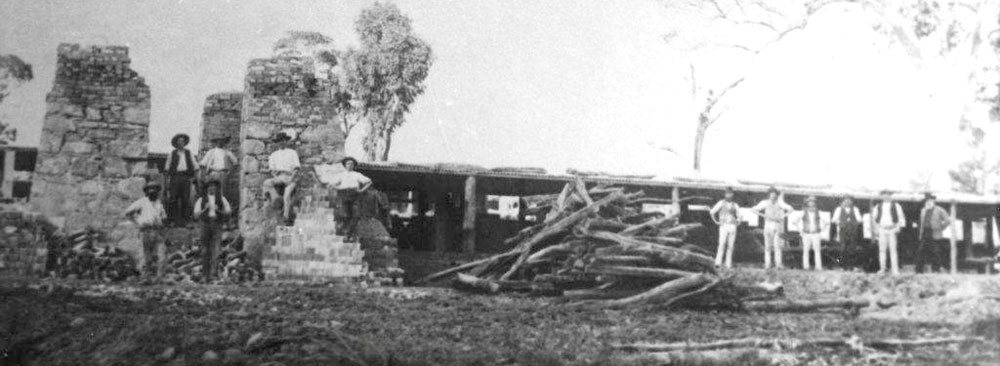
L.T. Watts Brickyard, Little Hampton
South Australian Firebrick Company 1893-1910
Not to be confused with the South Australian Brick Company, Brompton (1884), or the South Australian Co-operative Brick Company, Brompton (1937). Luke Watts sold 7 acres of land to George Thompson and George set up the The South Australian Firebrick Company with John Chapman as production manager. There was a dispute later over whether George Thompson had bought the business as well as the land. The land was reported to contain an unlimited supply of fireclay, rich in silica, while about an acre and a half is composed of the hard material from which the vitrified paving bricks were made. Three kilns, varying in size from a capacity of 19,000 to 45,000 bricks, were used. Building bricks, fire bricks, paving bricks, locomotive fire bricks and tiles were manufactured. In 1910, this company was taken over by the consortium of Adelaide investors that were seeking to establish The Littlehampton Brick Company.
Childs Brick Company 1895-1973
Two brothers, James and Stephen Childs, established this brickyard in 1895. They were experienced brickmakers having worked at the Coppin brickyard for many years (their mother was Ann Coppin). The brickyard was located on Childs Road. In 1902, Stephen Childs left the company and Edwin Miels became a partner. The company was called Childs and Miels Bricks. In 1917, Edwin Miels left and James took on his two sons, James Roy and Stanley as partners. The name became J.A. Childs and sons. In 1951, Stanley Childs withdrew and the company carried on with James and his two sons, Roy and Raymond. In 1973, the company ceased operation when the South Eastern Freeway was built over part of the company grounds. The location now has a sawmill and car wreckers on the site. Click Here for more information about this brickyard [.pdf]
The Enterprise Brickyard 1907
After leaving school, Charles Miels worked in the Coppin brickyard at Little Hampton. He then worked at the Childs & Miels brickyard. In 1907, Charles and G. Miels opened a brickyard on four acres on the corner of Hallet and Pioneer Streets. The called it 'The Enterprise Brick Company'. Their bricks had the initials EBC stamped in the frog. They were making building bricks, paving bricks and fire bricks using the hand making process. In October 1910, it was reported that the consortium of Adelaide based investors that were setting up the Littlehampton Brick Company purchased an option to acquire this company. In his obit in 1917, it was reported that he had also worked for Mr. John Chapman (South Australian Firebrick Company) and also the Littlehampton Brick Company.
Littlehampton Brick Company 1912-still operating
On 29 Oct 1910, 'The Register' newspaper had a public notice about the intention to form a new brick company at Littlehampton. The syndicate obtained an option to purchase the property and plant of the South Australian Brick Company, as well as 5 acres from the Miels Bros. and a 5 acre block belonging to Mr. H.A. Monks, opposite to the South Australian Brick Company works, and abutting the railway line. It was proposed to run a railway siding into Monks's block, erect the kilns on top of the embankment, and deliver the bricks to the trucks by means of shutes. By 1912, the Littlehampton Brick Company brickworks were operational on their new site. In 1979, the Fiora family bought the company and surrounding property.
Copyright randomfacts.com.au 2026
You may not reproduce or communicate any of the content on this website, including files downloadable from this website (unless otherwise indicated).
 enquiries@randomfacts.com.au
You may not reproduce or communicate any of the content on this website, including files downloadable from this website (unless otherwise indicated).
enquiries@randomfacts.com.au